
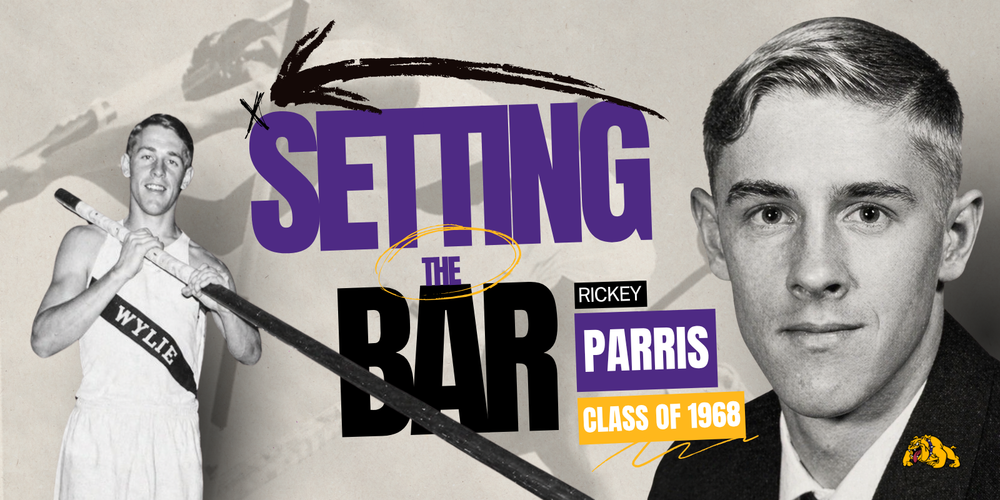
Records are made to be broken
Article by Greg Jaklewicz
Best UIL state meet pole vaults, 1907-68
15-1: Dickie Phillips, Galena Park North Shore (Class 4A, largest UIL class at the time), 1966
15-0: Eugene Beene, Abilene Cooper (4A), 1965
14-6: Larry Smith, Abilene High (4A), and Gary Hobson, Kermit, both 1964
14-4: James Riley, Mercedes (3A), 1966
14-2½ : Mark King, Midland High (4A), 1963
14-1½: David Jeffiries, Abilene High (4A), 1962
14-1¼ : Tommy Marshall, Yoakum (2A), 1963
14-1: Rickey Parris, Abilene Wylie (1A), 1968
His wife, Pug, tends to her stunning collection of irises, both front yard and back. Rickey Parris has only his small workshop in a corner of the backyard.
In the rafters are lumber scraps and PVC pipe of various lengths.
There are a few longer, tube-like pieces.
These would be Parris' pole-vaulting poles.
Back in the day, Parris was one of the best pole vaulters around. Billy Olson, the Abilenian who later would hold both indoor and outdoor world records, sought his advice for years.
In 1968, competing at his third Class 1A state track and field meet and finishing second as a junior, Parris soared 14 feet, 1 inch to win. At the time, it was the eighth best winning height since the event began in 1907 and the best by a Class 1A athlete.
Parris competed at McMurry University, where he won four national championships and cleared 17 feet at a meet hosted by Howard Payne University in Brownwood.
That’s a story we’ll get to shortly.
Parris and his athletic family in 2017 were inducted into the Big Country Athletic Hall of Fame. In 1989, he was inducted into McMurry’s Hall of Honor.
While he remains a Wylie Bulldog, Parris no longer has the school record.
In 2021, Kyle Aguilar flew 15 feet, 9 inches to win the Class 5A championship.
Records, they say, are made to be broken.
‘It didn’t scare me at all’
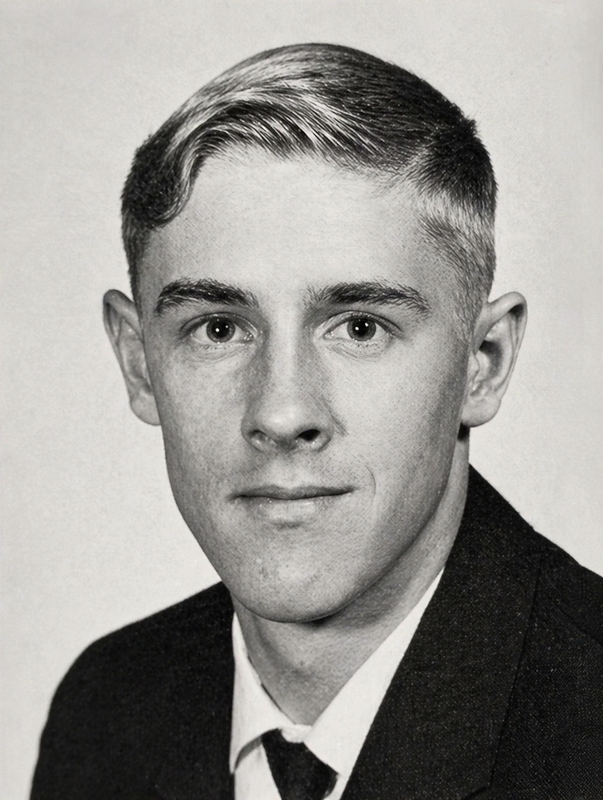 (Ricky Parris, Senior 1968)
Thanks to a coach named Stanley Whisenhunt, girls basketball was putting Wylie High on the athletic map in the 1960s. In fact, Parris’ sister, Carolyn, played on the Bulldogettes’ 1970 state championship team.
But track and field scored first when the late Dean Clark took first in the 180-yard low hurdles in 1963, and Parris brought home gold five years later.
“I was the second one, as far as I know,” Parris said of his individual track championship.
McMurry track coach Ronnie Giles had told Parris two weeks earlier that if Parris won in Austin, he’d get a full scholarship.
“I said, ‘OK, I’ll take you up on that,” said Parris, who had wanted to go to McMurry since he was a youngster. “I thought I could, and he did his part.”
That fulfilled Parris’ goal to compete in track at the college level.
The pole vault is perhaps in the most daunting track and field event. You run with a pole toward a small box planted in the ground. At full speed, you ram the pole into the box, bending the pole with the hopes of being flung into the air and over a bar set two to three times your height.
And hopefully land on something soft.
It’s one for daredevils.
The UIL only 25 years ago allowed girls to compete in the event.
“I didn’t care. It didn’t scare me at all,” Parris said. “The higher it went, the better it was, as far as I was concerned.”
In this era of high-tech equipment and intense training regimen, Parris was a caveman in the event. Learning how to pole vault was like discovering fire for him.
To get there, Parris had to teach himself, starting with a setup he erected in the front yard of the Floyd and Addie Parris home at South Fifth and Sunset streets in central Abilene.
Few coaches then knew much at all about the pole vault. They’d never done it.
There were no how-to YouTube videos to watch.
But Parris was up for high adventure.
Saturday morning cartoons got him interested in the pole vault. There were Wheaties cereal commercials in between the hijinx.
“They had a pole vaulter on there one time and I thought, ‘That looks like fun. I think I can do that,’” he recalled.
Parris got a pole that wouldn’t break (but also didn’t bend much). It was bamboo, a long stick otherwise placed inside carpet roles. His grandfather taped it, and he was set.
“The pit was a blanket,” he said.
“I got to be pretty good at it. By the time I got to seventh grade, I was jumping 11½ to 12 feet,” he said. I thought, ‘OK, I think I can do this.’”
Wylie was the launch pad
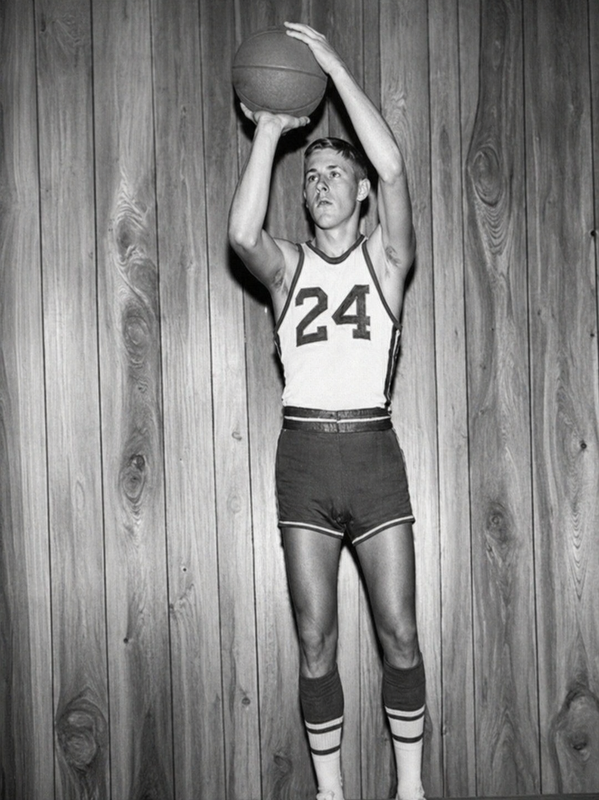
Parris attended Fair Park Elementary, one block from the house. He was a good athlete, if undersized. He was 5-foot-10 and maybe 145 pounds as a senior at Wylie.
He wanted to play all the sports and figured he couldn’t if he went on to Lincoln Junior High.
“I could’ve gone to Abilene High and pole vaulted, but I couldn’t have played basketball,” he said.
In those days, a student could transfer to another district, so Parris went to Wylie for seventh grade in 1964.
“It was the best thing for me. Small school. Knew everybody,” he said. “And I got to a lot of other things at Wylie that I couldn’t do in Abilene. I loved vo-ag and FFA.”
He honed his welding skills that his blacksmith grandfather had taught him, and he raised pigs and chickens to show.
He did get to play other sports. Parris played football for two years but when a friend injured a knee, he decided that he’d better off not playing if he wanted to compete in track in college.
But he played basketball and was a darn good. At 5-10, he was the center because he could jump so high. He was the only one on the team who could dunk two-handed.
“It was a technical foul if you dunked … but I did one time,” Parris said, a grin forming. “It was at Roscoe, and I got mad at this kid. You’d go down the lane and he’d just take you out. So I dunked over him. Oh, it ticked him off.
“Of course, I got a technical. Coach (Bud) Shelton said, ‘That was a good idea.’”
Wylie was salty in boys basketball, splitting games with 1968 state champ Aspermont.
That jumping ability translated to track. Parris said he cleared 6-8 in the high jump at a meet in Merkel. Straddling the bar, not flopping.
His other specialty was the long jump. He could sail more than 23 feet, and narrowly missed qualifying for the state meet.
Parris qualified in the high jump.
“I didn’t do very good. They had some really good ones there,” he said.
“I enjoyed it,” he said of all three track disciplines. “It’s just you doing it. I never worried about anyone else at meets.”
McMurry magic
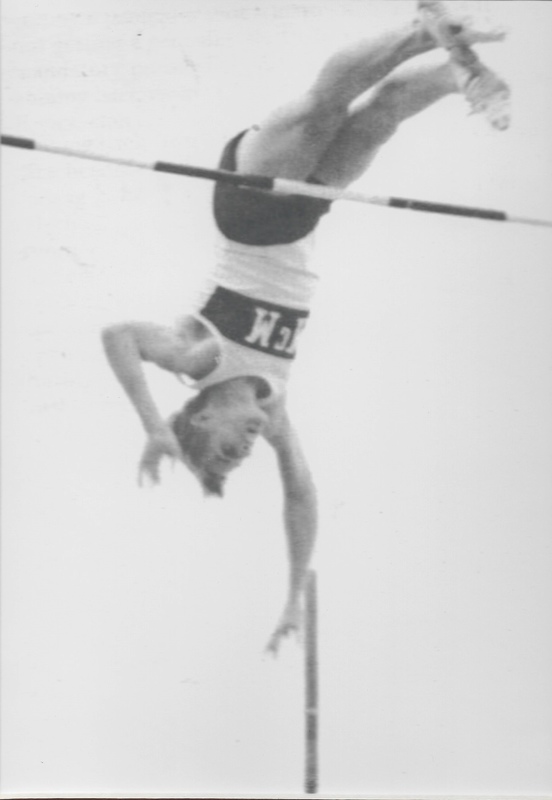 Photo of Parris clearing 17-01/2 at Brownwood to set NAIA record
Rickey Parris excelled at McMurry. His height progression was steady.
“Fourteen to seventeen is a pretty big difference,” he said.
Earlier this year, while assisting at his alma mater, he raised the bar to 17 feet to show a female pole vaulter how high he had gone. Her jaw dropped.
“Golly, that’s really high,” she told him.
At McMurry, he went four times to the national meet held in Billings.
“Why you’d hold it right on the Canadian border, I don’t know,” he said, shaking his head. The spring weather, however, held up.
Parris went 16-5 as a junior to win, though he said the wind was against them. The height, however, was the new NAIA record.
He won as a senior, but cleared only 16-0.
He won two indoor titles at meets in Kansas City. He went 16-8¾ as a senior to set another record.
“It was one of those fun times. You’re expected to win and you do jump pretty well and win. And then you’re there for two hours signing autographs for little kids,” he said.
Ups and downs
It was March 13, 1971, and Parris was at Cap Shelton Stadium for a meet hosted by Howard Payne. He had won the meet at 16-6 and asked that the height be set at 17 feet, which would be a conference and NAIA record.
There was a problem. The standards were not tall enough.
Where there is a will, there is a way. Nearby were wooden Coca-Cola crates next to a shed. Those were stacked on either side to achieve the height. It was just over 17 feet.
“I said, ‘That’ll work,’” he said.
With his parents and future wife looking on, he made it on his first jump, clearing a bar that was shaking a bit on unsteady support.
“They didn’t have any more boxes. I stopped,” he said, smiling.
How high could he have gone that day? Who knows.
The world record was only 11 inches higher.
One of the best
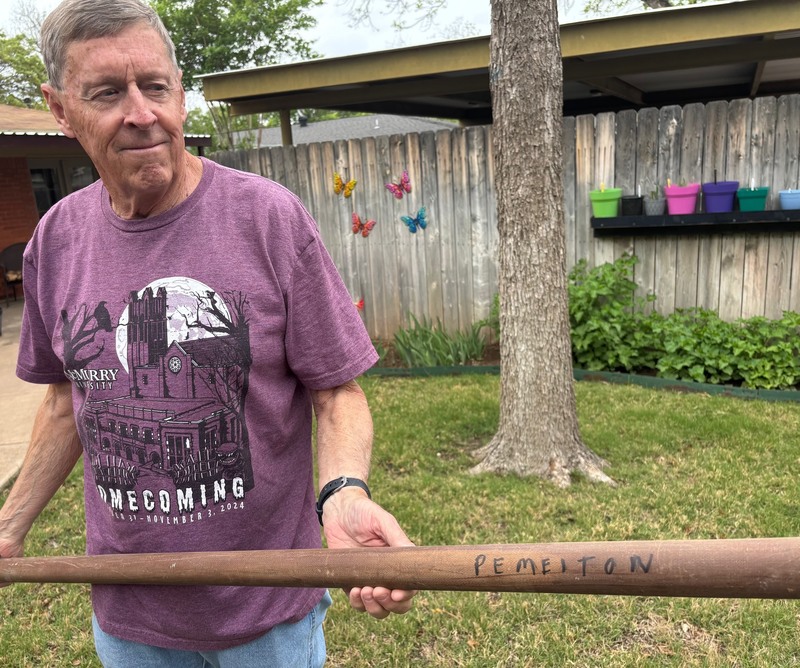 Rickey with one of Billy Pemelton's poles. Pemelton was third at 1964 Olympic Trials and 8th at the Olympics as an ACC track athlete
The list of great local pole vaulters is long.
It’s topped by Billy Olson, who won the event at the 1976 UIL state meet. Olson was the first vaulter to clear 19 feet indoors and topped 19 feet, 5 inches.
There’s Brad Pursley, a Merkel boy who was both an NAIA and NCAA champ and a three-time Olympic Trials qualifier. His best height was 18-10½.
For the record, the world record was reset on March 12; Armand Duplantis of Sweden cleared 20 feet, 8½ inches at a meet in Sweden.
That is more than four feet higher than Parris ever went.
After student teaching at Wylie, Parris took his P.E. degree to Mann Junior High in the fall of 1973 and taught there for 28 years.
Parris never was on the paid staff at McMurry but to this day, in some way, has assisted the track program.
Son Brad, who attended Abilene High and was third (15-6) at the 1995 state meet, also went to McMurry as a track athlete.
Dad’s records were broken.
Brad Parris 25 years ago set outdoor (17-9¼) and indoor (17-5¾) records while at his dad’s alma mater. Those records still stand.
In practice, he went over 18 feet. His 6-foot-4 frame - taller vaulters have better leverage - gave him an advantage over his father.
Brad Parris won five national titles at the NCAA Division III level.
Records are made to be broken.
“It was pretty neat,” dad said. “I always knew that he could.
“If anyone is going to break your records,” Parris said, “it’s nice that it’s your son.”
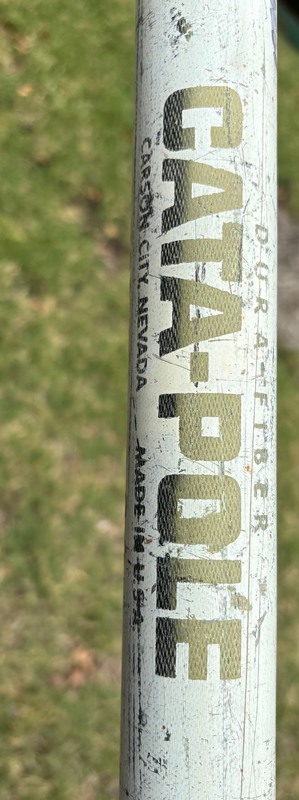
The Cata-Pole changed the game for vaulters as it was more flexible
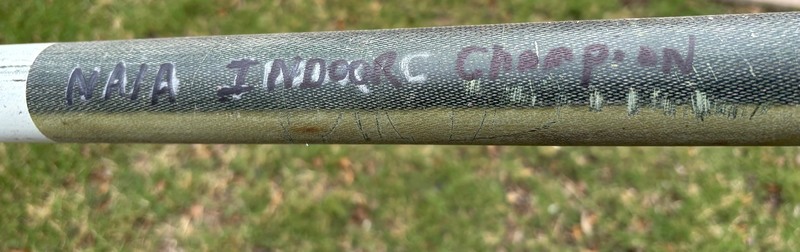
The pole he used to win an NAIA championship
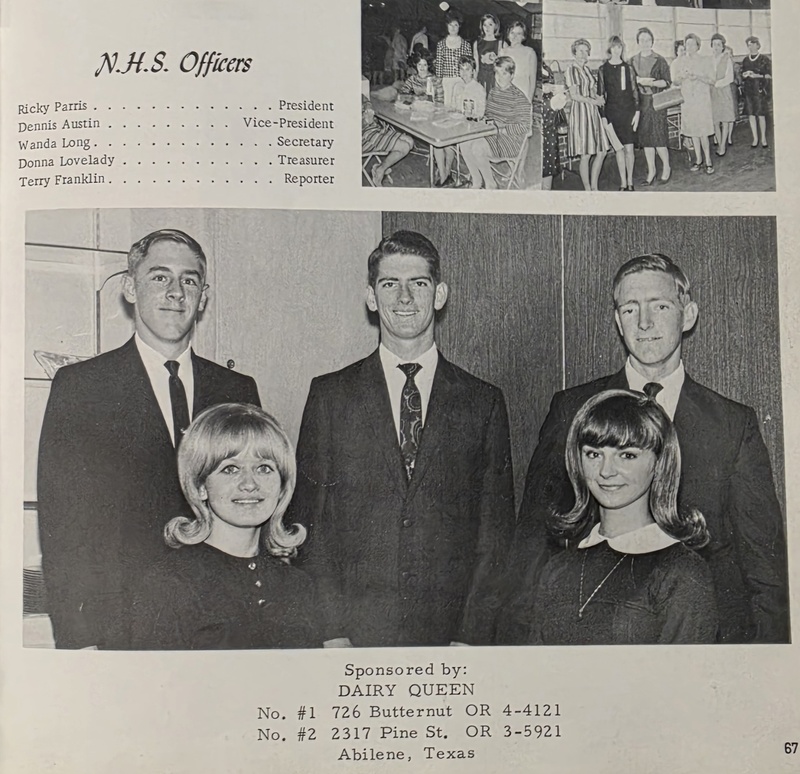
Parris, left, President of Wylie Senior Class 1968 National Honor Society