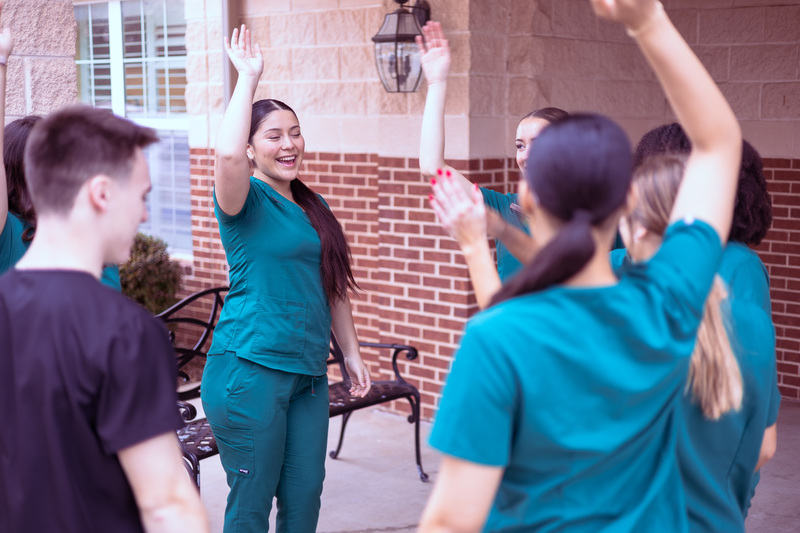
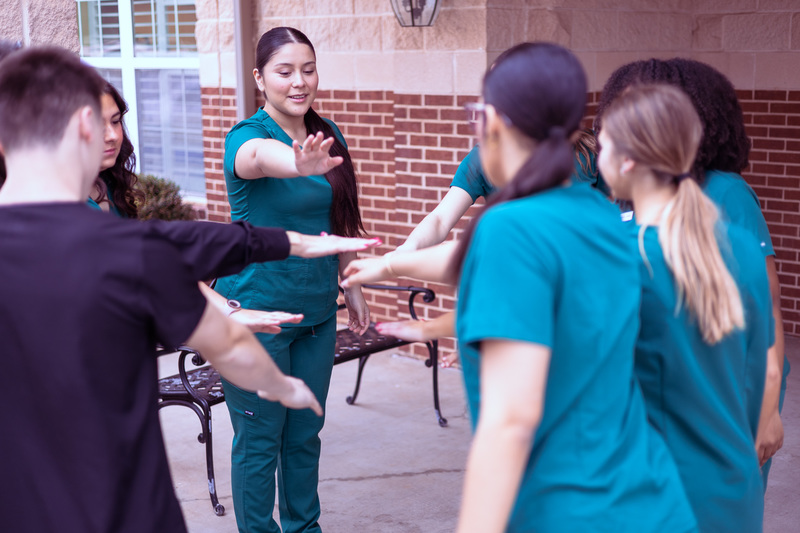
(The pregame huddle outside Wesley Court)
The bus doors fold open with a familiar sight, and out steps a line of Wylie students who look a little like they’re headed to a big game.
They’re in their scrub uniform. They’re in those white, waterproof shoes that say, I’m ready for whatever today brings. And as they gather on the sidewalk outside Wesley Court Senior Living, they don’t just stroll in like it’s another Wednesday morning.
They circle up.
Hands stacked. Bringing it in close. One last breath together.
“CNA, make their day!”
“CNA, let’s go slay!”
Then they break the huddle and walk through the entrance tunnel for what they half-jokingly call their two-hour “clinical gameday” — real residents, real routines, real learning that can’t be captured in a textbook.
This is Wylie ISD’s Certified Nursing Assistant (CNA) program in motion: a pathway built on skill, compassion, and the quiet understanding that caring for people is both sacred work and serious work.
And it’s changing students.
It’s changing residents.
And, in a small but steady way, it’s strengthening the fabric of our community.
Where the medical ladder starts
If you ask senior Shalom Haile what a CNA is, she doesn’t answer with a job description first. She answers with an image to ponder..
“There’s this expression that every job in the healthcare field is a step up the ladder,” she says. “And CNA is the one holding the ladder.”
It’s the kind of line that lands because it’s true.
In healthcare, the CNA role lives close to the ground level of human need. It’s not flashy. It’s not always easy. It is deeply personal. It is the work of noticing, assisting, and protecting dignity in the small moments — helping someone eat, helping someone stand, helping someone feel like themselves.
It’s also, as Wylie CNA instructor Dr. Lex Hood explains, one of the most practical doors a student can walk through if they’re serious about the medical field.
Students can graduate already certified, able to step into real work locally while also building a strong foundation for nursing school, medical programs, and other healthcare paths.
In other words, this isn’t pretend preparation.
It’s preparation with a credential at the end — and confidence that gets built along the way.
The classroom is where the confidence begins
Before students ever set foot in a clinical hallway, they earn their way in.
Dr. Hood explains that students build toward CNA through health science coursework. They apply. They’re recommended. They commit. And because class size is limited, students learn early that this opportunity is something you pursue with intention, not something you stumble into.
Once they’re in, the pace is steady and demanding.
The state requires CNA students to learn 46 skills, many of them tied to what healthcare professionals call activities of daily living — the things that make up an ordinary day for most of us, and the things that become the hardest when a body is tired, healing, or aging.
Students practice everything from making an occupied bed to taking vital signs, from safe transfers to safe feeding, from personal care routines to communication skills that protect a resident’s comfort and dignity.
And the learning isn’t casual.
There’s a written portion of the state exam, yes — but it’s the clinical skills exam that raises the heart rate. Out of the 46 skills, the test selects a small set that must be performed correctly, in order, with safety at the center. Little details matter. A missed safety step can cost a student the whole attempt.
That pressure is real.
But in Dr. Hood’s room, pressure is never the point. Purpose is.
Because students aren’t just memorizing steps. They’re learning why the steps matter — and why “doing it right” is a form of respect.
Why “residents” matters
Even the language in the program is intentional.
At Wesley Court, students are taught to say residents, not patients — because this is home.
Dr. Hood reminds students that when you enter a room, you’re entering someone’s space. Their routines. Their preferences. Their life. The work isn’t to take over. The work is to help.
That single word shift changes everything.
A “patient” can feel like a task.
A “resident” is a person who lives here — with a favorite chair, a preferred blanket, and a story that existed long before today’s schedule.
And that mindset shapes the way Wylie students show up.
Not as visitors.
As learners with humility.
Wesley Court: where the learning turns real
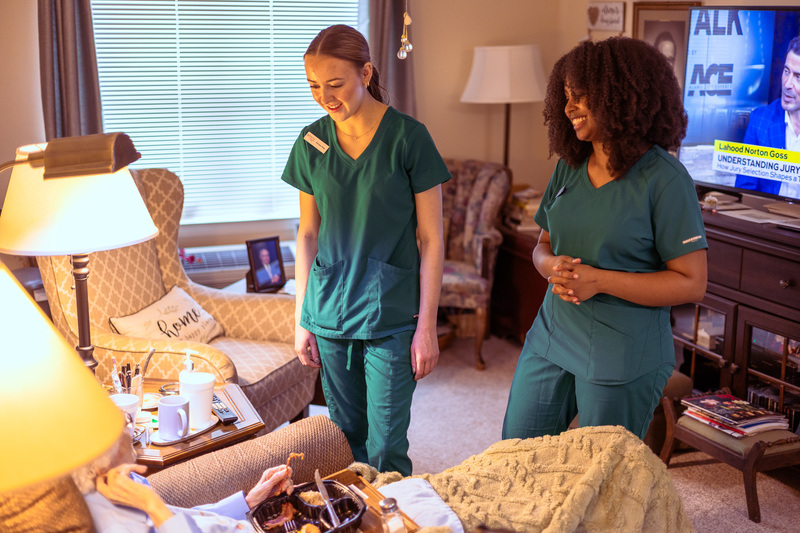 (Kenzee, left, and Shalom Haile, right, visiting residents)
For Wylie’s CNA students, Wesley Court Senior Living isn’t just a clinical site on a calendar. It’s where classroom lessons start to breathe.
Kala Spaulding, RN, DON, sees it every week. She’s not watching a school program from a distance — she’s watching students step into real responsibility in a real community, surrounded by residents who deserve care that feels personal, not hurried.
“Having Wylie students serve and learn alongside our residents brings a sense of purpose, joy, and connection,” Spaulding shared.
Many Wesley Court residents, she noted, spent their lives teaching, mentoring, nursing, raising families, and building Abilene into the place it is today. So when they see teenagers choosing a path of care, the emotion goes both directions.
Residents feel pride — the kind that says, Maybe the next generation is going to be alright.
And the students feel something, too — a level of meaning they didn’t fully expect.
What makes the partnership stand out, Spaulding says, is that it bridges generations. Students gain invaluable experience, yes. But they’re also giving something just as important: companionship, kindness, and a renewed sense of purpose to the residents who came before them.
In short, the learning goes both ways.
The clinical hallways are where it becomes a calling
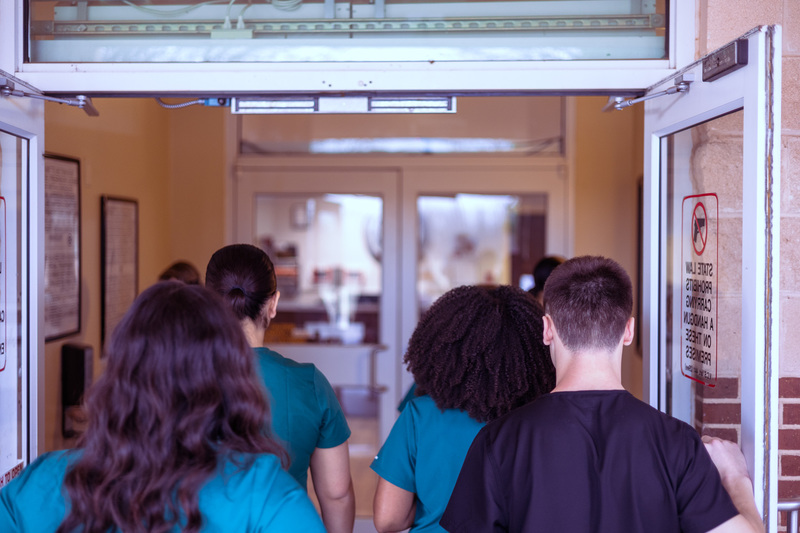 (CNA students move through their game-day tunnel)
Clinical days come with a rhythm.
Students arrive, straighten uniforms, and check nerves at the door. They wash hands. They pull gloves. They meet the CNAs they’re assigned to shadow. And then they ask the question that quickly turns into a full morning of work:
“What do you need help with?”
The state requires 40 hours of clinical experience, and Wylie students complete those hours at Wesley Court. That means real routines and real assistance — supporting residents with daily care, safe transfers, vital signs, feeding assistance, mobility, and the countless small tasks that keep a day steady and dignified.
There is no way to “fake” that learning.
And there is no way to leave unchanged.
Junior Layla Gonzalez describes it as humbling — the kind of experience that forces you to see life from more than one angle.
“You get to see both sides — your younger side, and what it can be like when you are older,” she says. “It is very humbling.”
Kenzee Petty says the clinical days have made her more grateful for the strength she usually takes for granted.
“Seeing people struggle to get out of bed… it makes you ten times more grateful to be able to get up and do the things that you do every day.”
And that’s the thing about this program.
It doesn’t just teach healthcare skills.
It teaches perspective.
Four students, four stories, one shared purpose
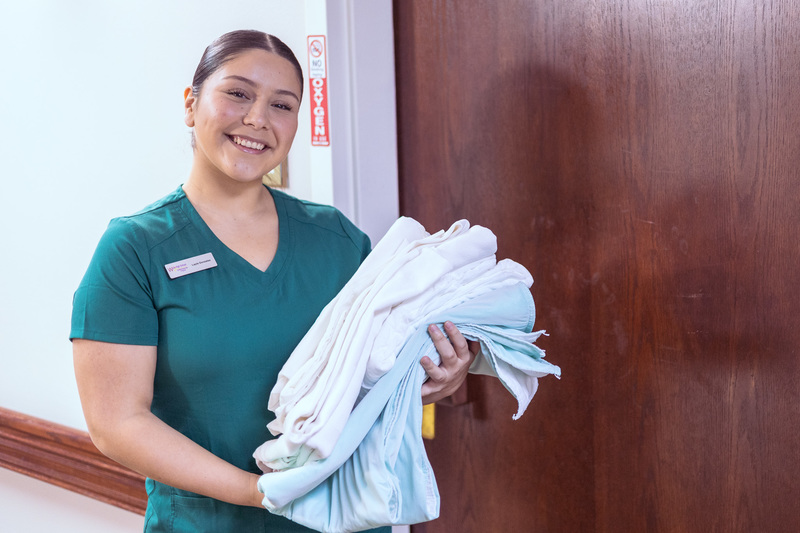 (Layla Gonzalez, changing fresh bed linens for residents)
The CNA program draws students for different reasons, and that mix makes the group stronger.
For Aubrey Castillo, healthcare feels like something she’s been walking toward for years.
“A lot of my family’s in the healthcare field,” she says. But her why isn’t just influence — it’s conviction. “I’ve had every opportunity in the world to quit, but I haven’t.”
Kenzee’s story is different.
“None of my family is in the healthcare field,” she says, laughing about a family rooted in farming and “other stuff.” But she remembers a moment — meeting a baby — when something clicked. “It felt so right,” she says, and she started imagining a future in labor and delivery.
Shalom’s story carries a whole world inside it.
She talks about her father coming from Africa and seeing what it meant to live without resources. She watched him restart his education here, work hard, and keep climbing — eventually becoming a doctor of nursing practice. Shalom says she wants to follow in his footsteps.
And Layla Gonzalez carries a different kind of motivation: generational hope.
She describes herself as first-generation — driven by the support of family members who didn’t have the chance to finish school and build careers the way they dreamed. “They are my backbone,” she says.
Different backgrounds.
Same hallway.
Same goal: to learn how to care well.
What surprises them most
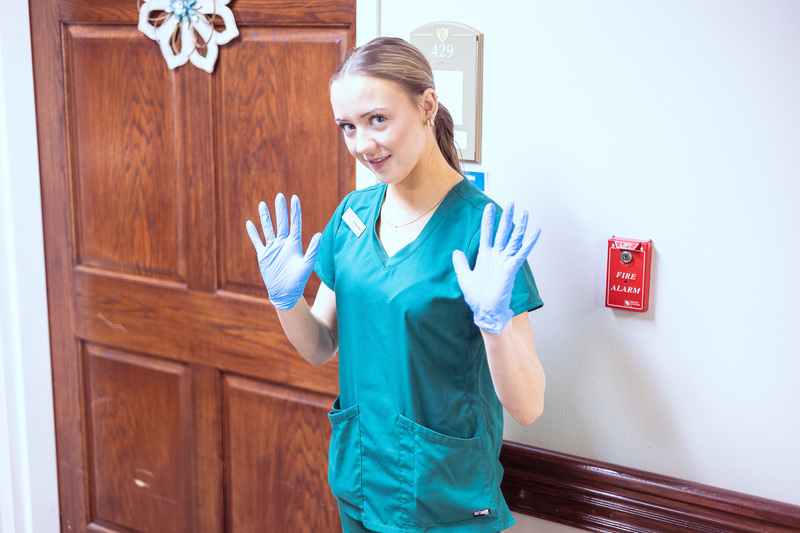 (Kenzee Petty showing off the gloves before assisting residents)
Ask students what surprised them, and you might expect them to mention the technical side — the steps, the checklists, the seriousness of clinical work.
They do, especially when they talk about how many details each skill includes.
“It’s just a lot of steps that you have to remember,” Kenzee explains. “Very repetitive.”
Aubrey points to skills like bed baths — processes with a particular order, a particular logic, and a particular purpose.
But the biggest surprise?
How meaningful it feels.
“It’s really rewarding,” Kenzee says. “I always leave… in a really good mood.”
Layla says the program changes the way students think about people, about aging, and about dignity. It also corrects some of the misconceptions teenagers sometimes carry about long-term care.
“A lot of people assume this work is only about the hard parts,” she says. “But there’s so much more to it — you’re helping someone feel comfortable, respected, and cared for.”
That’s what the program does so well. It doesn’t gloss over reality, but it also doesn’t reduce residents to tasks.
It teaches students to show up with skill and respect — and to leave with a fuller heart than they expected.
The moments that change everything
Some lessons come in quiet conversations, not skill checklists.
Kenzee shares one moment that shifted her mindset in seconds. She was talking with a resident and made a casual comment about how nice it must be to rest so much. The resident’s response stopped her.
“I wish I could get up every day,” he told her.
Kenzee says she didn’t think about it that way until then — and she hasn’t forgotten it.
Layla shares a different kind of moment — the kind you carry into your own life outside the building.
She spoke with a resident about her dance competitions and admitted she was nervous. The resident gave her what Layla calls a “never give up” speech, a steady reminder that persistence matters.
“It’s been forever stuck and replaying in my mind,” Layla says.
Kala Spaulding has seen those moments, too — and one stands out clearly.
She remembers a student noticing a resident having a difficult morning. Instead of rushing past the emotion, the student chose presence. She sat beside her. She held her hand. She listened. And by the end of their time together, Spaulding said the resident was smiling and laughing again.
That’s the hidden curriculum of CNA — the part you can’t bubble in on a test.
It’s learning how to make someone feel safe.
How to help someone feel seen.
How to bring calm into a moment that needed it.
Spaulding says she’s also watched students grow more comfortable over time, building relationships beyond the Healthcare Center and Assisted Living neighborhoods. Once they settled in, she said, they “blossomed” — connecting across the Wesley Court community in ways that surprised even them.
Independent Living residents now stop Spaulding in the hallway just to show her a card or handwritten note a student gave them — small gestures, but meaningful ones.
That’s what happens when students learn to care the right way. They don't just leave marks on paper. They leave them on people.
Compassion is the first skill
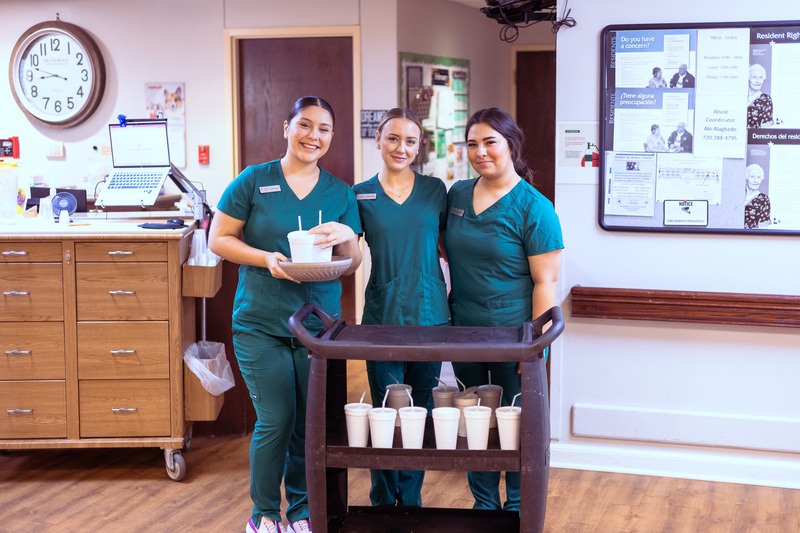 (From Left: Layla Gonzalez, Kenzee Petty, Aubrey Castillo)
Dr. Hood will tell you the program is built on compassion before it’s built on checklists.
When asked what qualities students need, she doesn’t hesitate: “Number one, they need to be compassionate.”
Students also learn to understand dementia — not as a single word, but as a broad umbrella that includes Alzheimer’s and other conditions. They learn how to meet residents where they are, how to respond when someone believes they’re late for work, and how to guide without correcting in a way that causes distress.
It’s not just medical.
It’s relational.
It’s communication, eye contact, patience, and the kind of gentleness that keeps someone safe during a deeply personal moment.
And yes, it can be emotional.
Not because the work is dramatic — but because it’s personal. After weeks of showing up at Wesley Court, students learn residents’ routines, favorite stories, and the little things that make someone feel comfortable. So when clinicals wrap up, Dr. Hood says many students feel a real tug in their chest.
They’ll say, “I’m going to miss them,” and you can tell they mean it.
That isn’t a weakness.
That’s evidence of connection.
An invitation to future Bulldogs
(One of three groups that visit Wesley Court)
If you’re an eighth grader walking through a CTE Preview Night, it can be hard to picture what your future self might want.
But listen to these students, and you’ll hear a theme: start early, stay focused, and choose something that matters.
Aubrey tells younger students not to drift through the early years of high school. Set goals. Take it seriously.
Kenzee adds that you can’t build your life on other people’s opinions. “You just have to do what your gut’s telling you.”
And Shalom’s ladder image hangs in the air like a challenge and a comfort all at once: if you’re not sure where you fit in medicine, CNA may be the place you learn what caring truly requires — and the place you decide what kind of professional you want to become.
Because at Wesley Court, students aren’t practicing on mannequins or pretending a scenario is real.
They’re helping real residents have a better day.
They’re learning to enter a room with respect.
They’re discovering that dignity is built from a hundred small choices — a calm voice, a locked wheelchair, a shirt offered with options, a moment of patience instead of a rush.
And when they step back onto that bus, there’s often a different look in their eyes than when they arrived.
A little more confidence.
A little more gratitude.
A little more heart.
It’s great to be a Wylie Bulldog.