

Wylie Students Bring Home Three State UIL Academic Championships
Article by Greg Jaklewicz
Some of Wylie High School’s brightest students took a road trip this week.
For the seniors in the group, it was one last effort for their dear almost-alma mater. And by the time the medals were counted, Wylie’s UIL Academics team had made the trip home from Austin with three State Championships.
Garrett Dowell, geography teacher and UIL academics coordinator, sent 12 students in seven events to the UIL Academic State Meet on the campus of the University of Texas.
The trip south came just days before the competing seniors become 2026 graduates.
Wylie had already turned in a strong showing at the Region I meet in Lubbock, finishing second overall. Argyle, Wylie’s nemesis in so many extracurricular activities, took first place. Wylie also was second in 2025.
Yep, Argyle was first.
But this week in Austin, the Bulldogs had plenty of their own gold to celebrate.
Three State Champions for Wylie
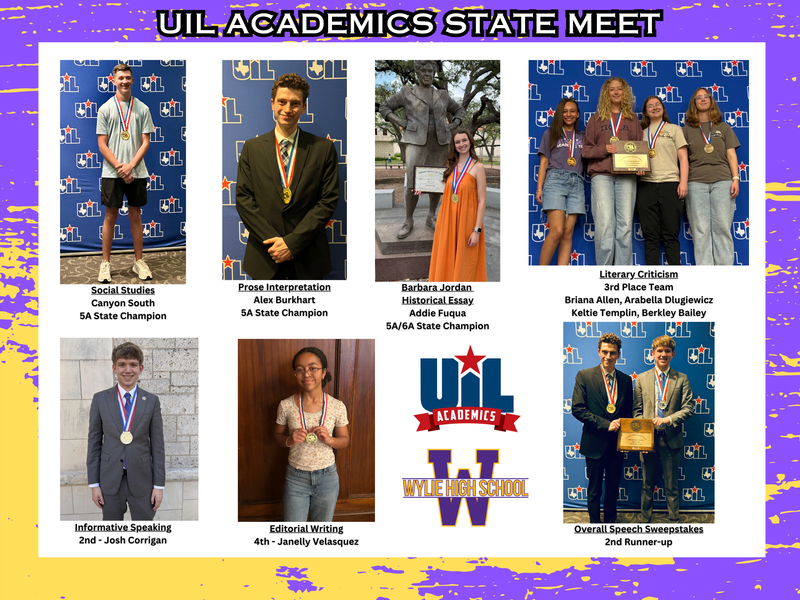
Canyon South captured the Social Studies State Championship, earning the highest overall score of all 1A-6A schools in Texas.
Alex Burkhart claimed the State Championship in Prose Interpretation, continuing the Wylie Theatre Department’s tradition of excellence.
Adeline Fuqua also made school history by winning the combined 5A/6A division of the Barbara Jordan Historical Essay Contest, an event Wylie began competing in just last year.
It was an outstanding showing for Wylie on the state stage.
A state champion in social studies back in his day, Dowell believed his group had a chance to put their pedals to the medals in Austin.
They did just that.
Skills That Stand the Test of Time
Some events have remained the same over the decades. Some are newer, reflecting changes in education.
Adios, slide rule. Hola, written and programmed computer science.
Still, being able to read, write, do math, speak, employ creativity, organize and perform under pressure remain essential skills. So is putting in the hard work that it takes to be a champion.
To a student, hard work is the backbone of natural ability.
And for this group, that hard work showed up when it mattered most.
Competing for WHS
Competing for WHS at the state meet were:
Josh Corrigan, informative speaking, Region I winner
Alex Burkhart, prose interpretation, Region I winner and State Champion
Briana Allen, Keltie Templin, Arabella Dlugiewicz, and Berkely Bailey, literary criticism, Region 1 winner
Janelly Velasquez, editorial writing, second place at region
Michael Dalley, Joshua Varghese, Dlugiewicz and Canyon South, social studies, second place at region
Tristan Bolivar, spelling-vocabulary, second place at region
Addie Fuqua, Barbara Jordan Historical Essay, state finalist and State Champion
Not competing at state but taking second place in Lubbock was the spelling and vocabulary team of Benton Hanner, Cindy Do, Tessa Jones, and Bolivar.
Only the first-place teams from the four Texas regions advance to state, along with one wild-card team. Wylie’s social studies team made it, but its second-place spelling-vocabulary team did not.
However, third-place individual finisher Bolivar joined the Wylie group bound for state.
A Busy Week for Dlugiewicz
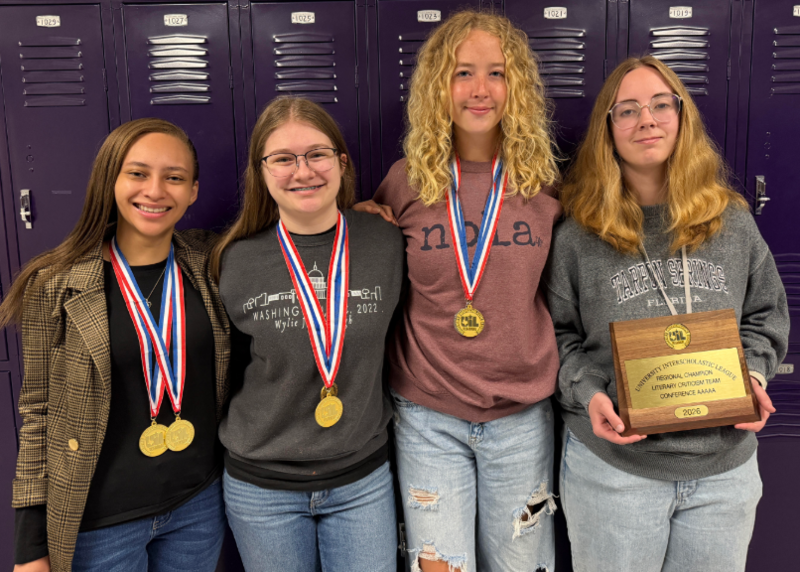
(Briana Allen, Keltie Templin, Arabella Dlugiewicz, Berkley Bailey)
Not only was Dlugiewicz, a senior, competing in two UIL academic events, she had just returned from San Antonio, where she competed in the state girls doubles tennis tournament with junior Mia Martinez.
She also is graduating third in her class.
Some seniors try to coast toward graduation.
Dlugiewicz, apparently, prefers the scenic route - through tennis courts, testing rooms and one very full calendar.
What the Events Require
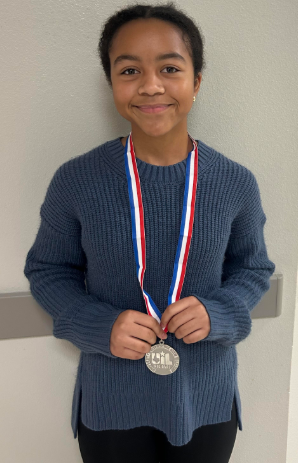 (Velasquez)
Some events are easy enough to explain. Freshman Velasquez, for example, is given a topic for an editorial and a quantity of information. Her job is to select the most pertinent information and organize a winning opinion.
She has only minutes to strike gold.
Other gold medals require months of preparation.
Dowell had especially high hopes for South, a senior with the ability to knock out a perfect score in his event. Perfect scores are rare.
South did more than deliver. He became the Social Studies State Champion and earned the highest overall score of all 1A-6A competitors in Texas.
A good memory is a good tool for UIL events, whether it’s a fact or a strategy. Some say today’s younger generation can’t remember anything.
These students disagreed.
“If you put it through your head quite a few times, I think you can,” South said. “You can remember most of anything. It takes time.”
Going Out With a Bang
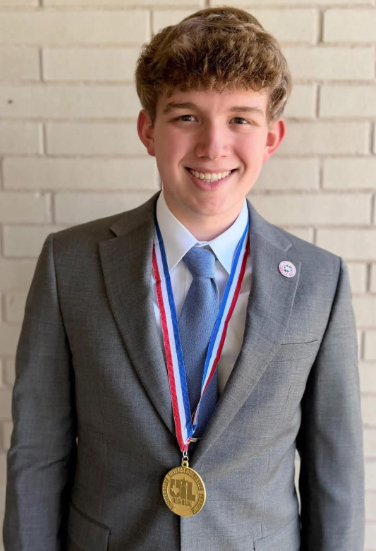 (Corrigan)
The Wylie contingent went to Austin on the same day, but not all together because the event schedule and locations varied.
Before the trip, Corrigan, a senior, was asked if it was still important to do well for Wylie, especially for the seniors.
“I think so. After we compete, we’re done. We’ve got like two days and then we graduate. So it was one of those things, go out with a bang.
“It’s a surreal experience for me, going all four years. Going to Austin has been a really fun experience.”
For the seniors, the State Meet was more than another competition. It was one more bus ride, one more round of preparation, one more chance to wear Wylie across their chest before walking across the stage.
Recently, Dowell was able to corral a group of qualifiers to talk about their events. Here is what they had to say.
Dalley and South, Social Studies
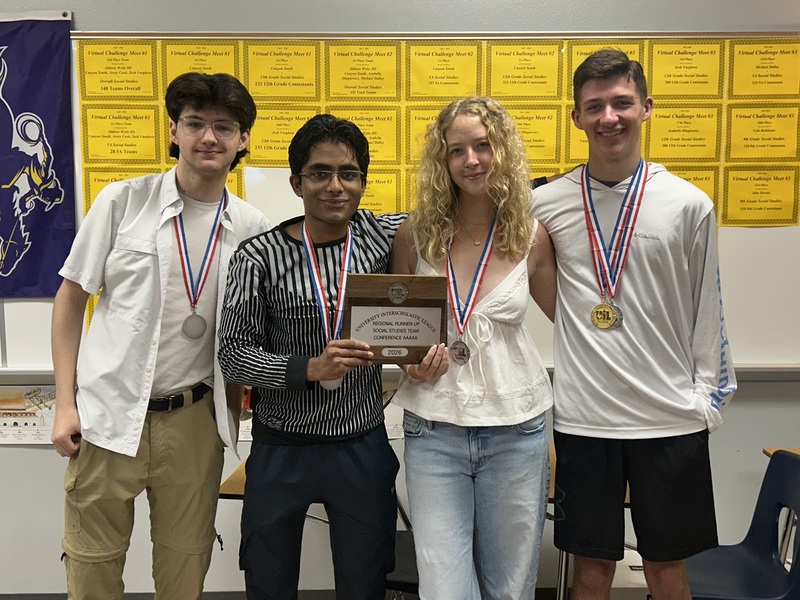
This was Dalley's second rodeo. How’d he do last spring?
“Not super well,” he said, admitting he didn’t put in the effort that South did.
Team members compete individually, with a maximum of 80 points from objective scoring and 20 points from an essay.
The team score comes from the combined total of the three highest team members. The fourth member’s total is used as a tiebreaker.
Topics can be drawn from the world at large or just the United States.
This year’s topic was the Cold War. The topic was released last May and students had all this time to prep for excellence. Lists of influential people and terms are provided, and a book and a set of documents about a certain event must be read.
Competitors are asked 20 questions about people and terms, 15 questions about the book, and 10 questions from the documents.
How much did you know about the Cold War?
“Not a lot,” South said. “Usually, it’s a big learning experience every year.”
This was South’s fourth year to compete in the event and third year to advance to the state meet. He was second in Region I last year and fifth at state as an individual entry. In 2024, Wylie was second as a team and Region I champ as South took 10th place. Wylie was fourth at the Region I meet in 2023, South’s freshman year, when he was seventh in Lubbock.
The team’s goal this year was first place.
“That’s the goal, as always … to win,” said Dalley, a senior. “Currently, we’re doing pretty well, so we’re looking toward winning.”
South reached that goal, winning the Social Studies State Championship and finishing with the highest overall score of all 1A-6A schools in Texas.
Templin and Allen, Literary Criticism
Templin was on a powerhouse all-senior team. Two teammates finished 1-2 in Lubbock, and she was fourth.
What in the world is literary criticism?
“Kinda like social studies, they give you books to read. We can a book, a play and a group of poems,” she said.
This year’s book was Harper Lee’s “To Kill a Mockingbird.” The play was “The Iceman Cometh” by Eugene O’Neill. The poems were sonnets by Shakespeare.
Nothing very new.
The first 30 questions in the competition are drawn from a study list of 500 or so terms. The rest of the test, she said, is poetry.
“Sixty-five questions, you have 90 minutes,” Templin said. There also is an essay, used only as a tiebreaker. If you don’t write one, she said, you are disqualified.
Did she expect first place in Lubbock?
“Well … yeah,” she said, smiling.
A year ago, she was sixth at the Region I meet and did not advance to state.
“So this is really awesome,” Templin said.
Templin had at least one year of experience to work with.
Allen was competing for the first time.
“I used to do computer science,” she said. Though she plans to major in computer science in college, she didn’t seem to “click” with studying for and taking the test.
She switched events, almost choosing social studies, and won a regional title. Easy peasy.
Allen said she remembered what she was taught in English classes.
Take a bow, teachers.
“I thought it would help me study for the AP literary exam,” Allen said.
Corrigan, Informative Speaking
Corrigan was hoping to leave WHS with a bang. This was his fourth year to compete in the event, and all four years he advanced to the state meet.
He finished third in 2023, 2024 and 2025 at the Region I meet to qualify. Last year, he took sixth place at state as a junior.
This year, he entered the state competition as the Region I champ, with hopes of a medal showing.
“Hopefully, this time, we’ll get the gold. I’m tired of sixth place,” he said, smiling.
In this event, six to eight entrants are in a contest room.
The first student draws five topics from a bin of topics, picks one and puts the others back, then begins the 30-minute process of preparing a 7-minute speech. The topics are random but focus on current events.
They are familiar with the topics if they have been keeping up with current events during the school year. The challenge is to organize a wealth of content and pick a topic that the competitor can exploit into an informative speech.
There can be multiple rounds. At the state meet, there were preliminaries Monday and the final round Tuesday.
In Lubbock, Corrigan drew topics ranging from Chinese involvement in South America to the issue of birthright citizenship that has gone before the U.S. Supreme Court.
How many high school students would be experts on those subjects? Few, so preparation is key.
Pressure?
“Yeah, but …,” Corrigan begins.
The idea is to have a plan.
“You just plug and play,” he said, regardless of the topic. “You have a set substructure. You just have to find the articles that fit. It gets easier. You just build the aptitude for it.”
Burkhart, Prose Interpretation
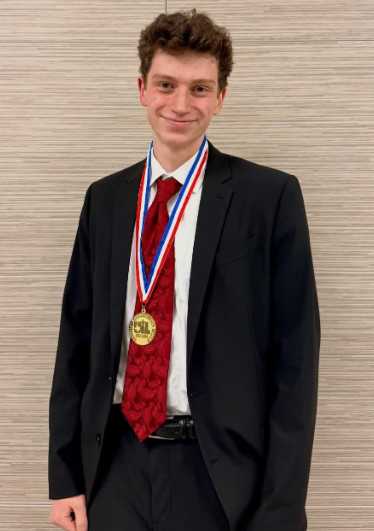 (Burkhart)
A junior, Burkhart already had a big year before the state meet.
“I didn’t even make the team last year,” he said, laughing.
How did he make such a big jump to Region I champ?
“A lot of it was I was held back and inexperienced,” he said. “This year I was more outgoing and bold in the choices that I made in the competition. And I chose humorous, comedic pieces that I could do naturally.”
That boldness carried all the way to Austin, where Burkhart claimed the Prose Interpretation State Championship.
Like Corrigan, there is a group of competitors in a room. They also are prepared for the day.
“We have a book binder that has a story in it. We’re going to read the story and tie it into a little intro. You can do a little bit of acting but they don’t want too much. You’re judged on how well they followed along with the story and your creative elements.”
The story can be about anything, he added.
“Dramatic to humorous,” Burkhart said.
“Mine is my dad was raised by wolves, and he tries to teach me to be a wolf. I have had this story since October. You have seven minutes to read off this story,” he said. “It doesn’t have to be memorized.”
Being an animated and engaging storyteller is important, but this is not a theatrical presentation, he said.
Still, it takes timing, presence and the kind of confidence that can hold a room.
Burkhart held the room, and then he brought home gold.
Bolivar, Spelling and Vocabulary
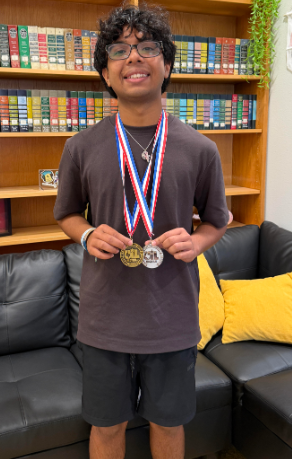 (Bolivar)
Bolivar had spelling bee success in seventh grade but then stopped, he said.
He skipped UIL his freshman year but came back with a vengeance. He was on the second-place regional team and was third place overall.
What makes a good speller?
“A lot of memorization, honestly,” he said.
Students are provided a list of words and alternate spellings. They study that but also must be prepared for random words that count for 20 percent of the contest.
Velasquez, Editorial Writing
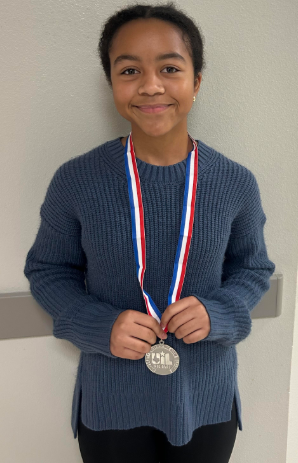 (Velasquez)
This was Velasquez’s first year to compete.
“The only reason I joined is that my English teacher convinced me. I never thought I was that good at writing but she told me that I was a good writer and I should join journalism,” Velasquez said.
Students are given a prompt and must choose a side. The bulk of the editorial is citing evidence to support the writer’s argument. The opposing viewpoint must be addressed for balance, but it must be debunked by the editorial writer.
“I would say that my strongest point is having the evidence to back it up,” she said. “Saying yes, this is right, and no, this is wrong.”
Her Region I topic was if school-administered Breathalyzer tests upon entrance to events such as proms should be allowed.
Fuqua Makes School History
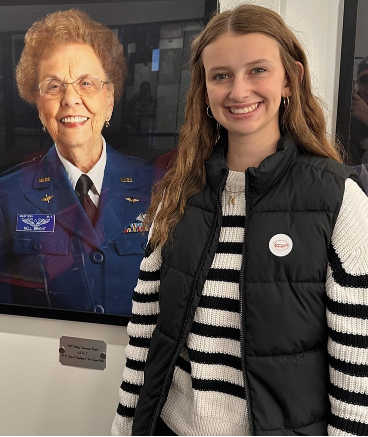 (Addie Fuqua)
Fuqua entered the Barbara Jordan Historical Essay Contest as a state finalist.
She left as a State Champion.
Fuqua won the combined 5A/6A division of the contest, making school history in an event Wylie began competing in just last year.
That kind of moment says something about a student, of course. But it also says something about a program willing to try something new, teachers willing to guide students into unfamiliar territory, and students willing to step forward before a tradition has even had time to settle in.
A Proud Finish for Wylie
UIL academics is not always loud.
There are no stadium lights, no marching band at halftime, no crowd rising to its feet with every answer. Much of the work happens quietly - in classrooms, practice rooms, study sessions and the long stretch of preparation between region and state.
But this week, Wylie’s academic competitors made plenty of noise in their own way.
Three State Championships. Twelve state qualifiers. One outstanding showing for Wylie High School.
For the seniors, it was a final chance to represent Wylie before graduation. For the younger students, it was proof that the road to Austin is always open for those willing to put in the work.
And for everyone back home, it was one more reminder that it’s great to be a Wylie Bulldog